
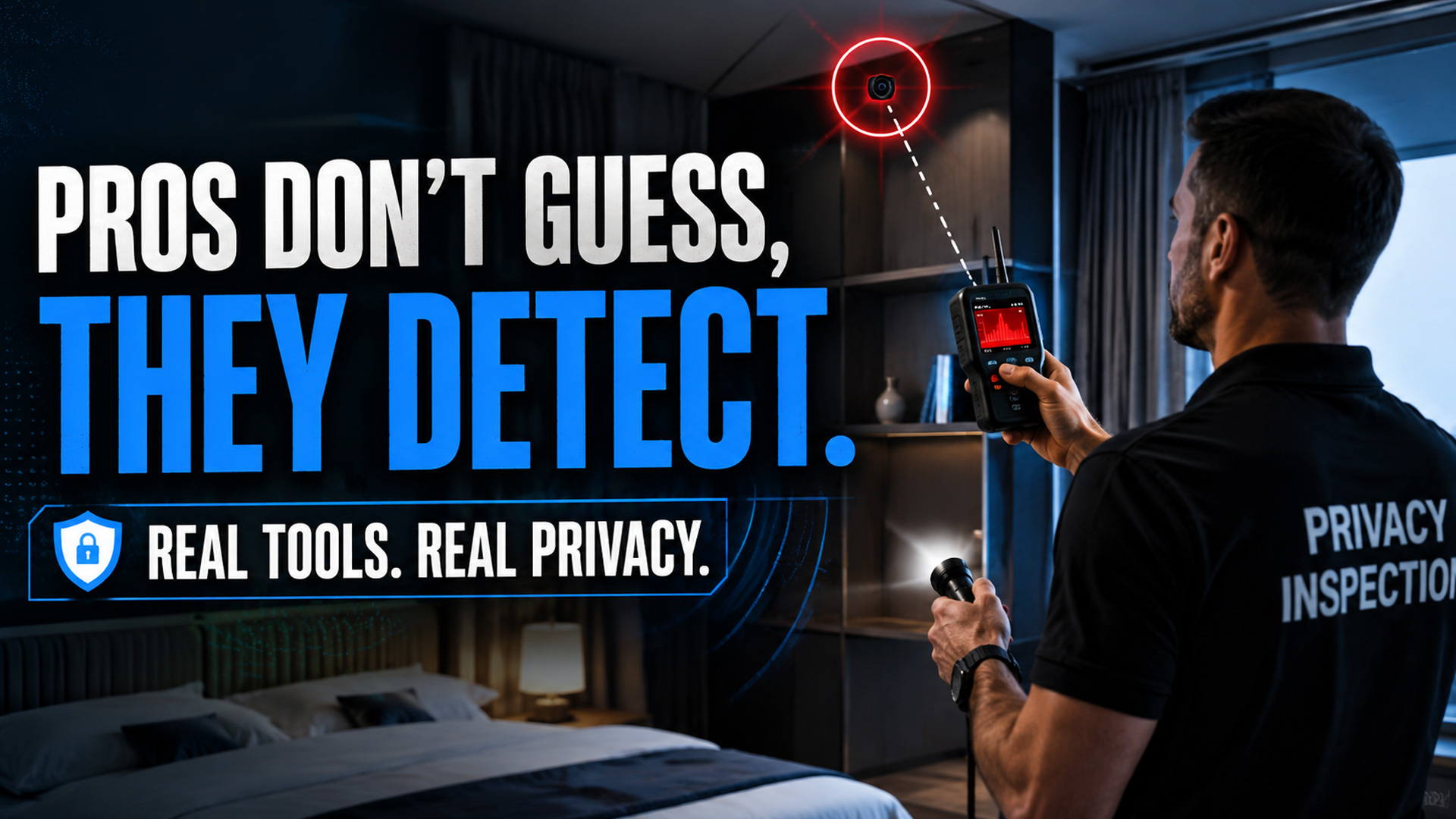
There might be times, after renting out a room in a hotel, that you wonder whether something is off. Possibly, it has been inspired by the multitude of tales you’ve heard about tiny cameras hidden inside Airbnbs. That’s a normal feeling. Besides, using a simple app on your smartphone to scan for bugs is quite different from the work of a real TSCM expert who comes in the room with the hidden camera scanner.
The former can give you some reassurance, whereas the latter is a thorough and scientific privacy checkup. Naturally, you might wonder, what exactly is going on during the sweep? Well, today, I’d like to go through it with you.
Quick Answer
A hidden camera detector and bug detector are used together by experts who inspect a room to identify covert surveillance equipment. These include listening in on RF signals, spotting reflections from lenses, and finding wired devices that may be hiding among normal stuff. A thorough privacy scan incorporates electronic detection tools and also manual physical searches because no one tool will pick up every potential threat. It’s this comprehensive method rather than just moving a gadget around that distinguishes a real TSCM sweep from a five-minute phone scan.
Why a Single Device Isn’t Enough
Here’s a fact many people discover too late: when they witness sweeps on the spot, there is no magic wand. The camera detector works like a charm when lens glints and certain types of wireless transmissions are involved. But the problem is that if the camera is storing the footage on an SD card and not sending any signal, it won’t be detected in such a way. That’s why people with a good knowledge in such matters are never fully dependent on one tool.
A proper inspection blends a few different methods together:
Radio frequency bug detection: Most bugs and wireless cameras have transmitters and they can send signals to remote devices and therefore they need bug detectors to discover such bugs by detecting a change in the RF (radio frequency) activities in a room. Analog bugs, digital transmitters, GPS trackers left by a former partner or business rival can be caught eventually with the help of RF detection if you have a knowledge of what frequencies to listen for.
Lens detection: Hidden camera detector is where this feature is most useful. This is the method whereby these camera detection devices use a group of LEDs which often goes together with a lens on a smartphone or dedicated viewer that makes a camera lens reflect back light clearly. It is possible that a smoke detector, clock radio, power adapter, picture frame, or any other device with a pinhole lens lights up through this type of scan, regardless of whether the device is switched on or transmitting.
Physical investigation: The physical part is the way most devices are captured. Technicians who have a lot of experience are aware of the favourite places for hiding, hidden in a wall socket, located behind vents, hidden in a smoke alarm, plugged into USB chargers that hadn’t been used before. A physical check would involve removing screws, going through mirrors, and scanning for anything that might seem different or newer than the rest in the room.
Network analysis: More nowadays, devices connect to Wi-Fi as opposed to broadcasting a signal. One way of identifying a camera is scanning the local network, looking for unfamiliar devices, reviewing router logs and finding irregularities related to data consumption. This is how network analysis finds a camera that was not detected by RF method.
What a Real Sweep Looks Like Step by Step
When a technician actually gets called out for a privacy inspection — whether it’s a boardroom before a sensitive meeting, a rental property, or someone’s home after a messy separation — there’s a fairly consistent process:
- Initial consultation. Working out why the sweep is needed shapes the whole approach. A corporate boardroom sweep looks very different to checking an Airbnb bathroom.
- Baseline RF scan. Before touching anything, a technician will often do a baseline sweep of the room’s ambient signal environment, so they know what “normal” looks like before hunting for anomalies.
- Camera and lens detection. Using a dedicated hidden camera detector, the room gets scanned methodically — smoke detectors first, then clocks, mirrors, power points, anything with a small hole that shouldn’t be there.
Bug detector sweep. A separate pass with a bug detector picks up transmitting devices that a lens scan might miss, including audio-only bugs with no camera component at all. - Physical search. Vents, furniture, behind picture frames, under desks — the boring stuff that actually finds the boring, low-tech devices most amateur checks skip entirely.
- Documentation. Anything found gets photographed and logged, and depending on the situation, this documentation might end up supporting a police report or a civil matter.
Where This Comes Up Most Often
It’s not always dramatic corporate espionage stuff, even though that’s what people picture. Some of the most common callouts we see are:
- Short-term rental guests worried about a previous stay or a landlord acting oddly
- People going through a separation who suspect a partner installed something before moving out
- Small business owners preparing for a confidential meeting or product launch
- Landlords wanting to reassure tenants after a complaint
- Anyone who’s just moved into a new place and wants a clean-slate check
Why DIY Apps Fall Short
Okay, phone apps definitely aren’t completely redundant, they can detect some very obvious stuff that’s easy to spot. But they are constrained by the capabilities of the phone camera sensor and besides that, they lack the specialized lenses and precisely adjusted radio frequency range, which are a part of professional grade equipment that is used for a specific purpose. The main point here is, an inexpensive 0 dollar app scan is nothing compared to an extensive TSCM examination where equipment is commercial-grade. They may appear very similar when looked at only from paper level description but really, they are doing two totally different things. If it is a real concern, a legitimate one not just out of curiosity, you should get someone who does this full-time to actually go through your place.
Conclusion
A hidden camera detector is a handy little device indeed, but it is only one segment in more comprehensive approach that the experts who do this professionally usually rely on. Together with a bug detector, these people are quite familiar with places one would conceal the devices and they are willing to spend enough time on the job to get it done right as opposed to merely scanning through the spot and taking off afterwards. One should realize that if a person’s primary concern is his or her privacy, then, actually, thoroughness is the key factor in the whole matter rather than a good-looking single piece of equipment that will probably not do as well.
FAQ
Q: Can a hidden camera detector find cameras that aren’t recording live?
A: Yes, to an extent. Lens-detection tools work by reflecting light off a camera’s lens, so they can spot a device even if it’s not actively transmitting footage, as long as the lens is exposed.
Q: How long does a professional privacy inspection usually take?
A: For a single room, it’s typically 30 to 60 minutes. Larger spaces like offices or whole houses can take a few hours depending on how many items need checking.
Q: Is it legal to sweep a rental property for hidden cameras?
A: Generally yes, checking your own accommodation for privacy devices is legal. If a device is found, what happens next may involve reporting it to police or the platform, depending on the circumstances.
Q: What’s the difference between a bug detector and a hidden camera detector?
A: A bug detector picks up radio frequency transmissions from devices like audio bugs and wireless cameras. A hidden camera detector specifically targets lens reflections, catching devices a pure RF scan might miss, including cameras that record locally rather than transmit.
Q: Can I just use a flashlight to check for cameras myself?
A: It can help spot obvious lens glints in a dark room, but it won’t catch everything, especially well-hidden or non-reflective setups. It’s a decent first step, not a substitute for a proper sweep.