
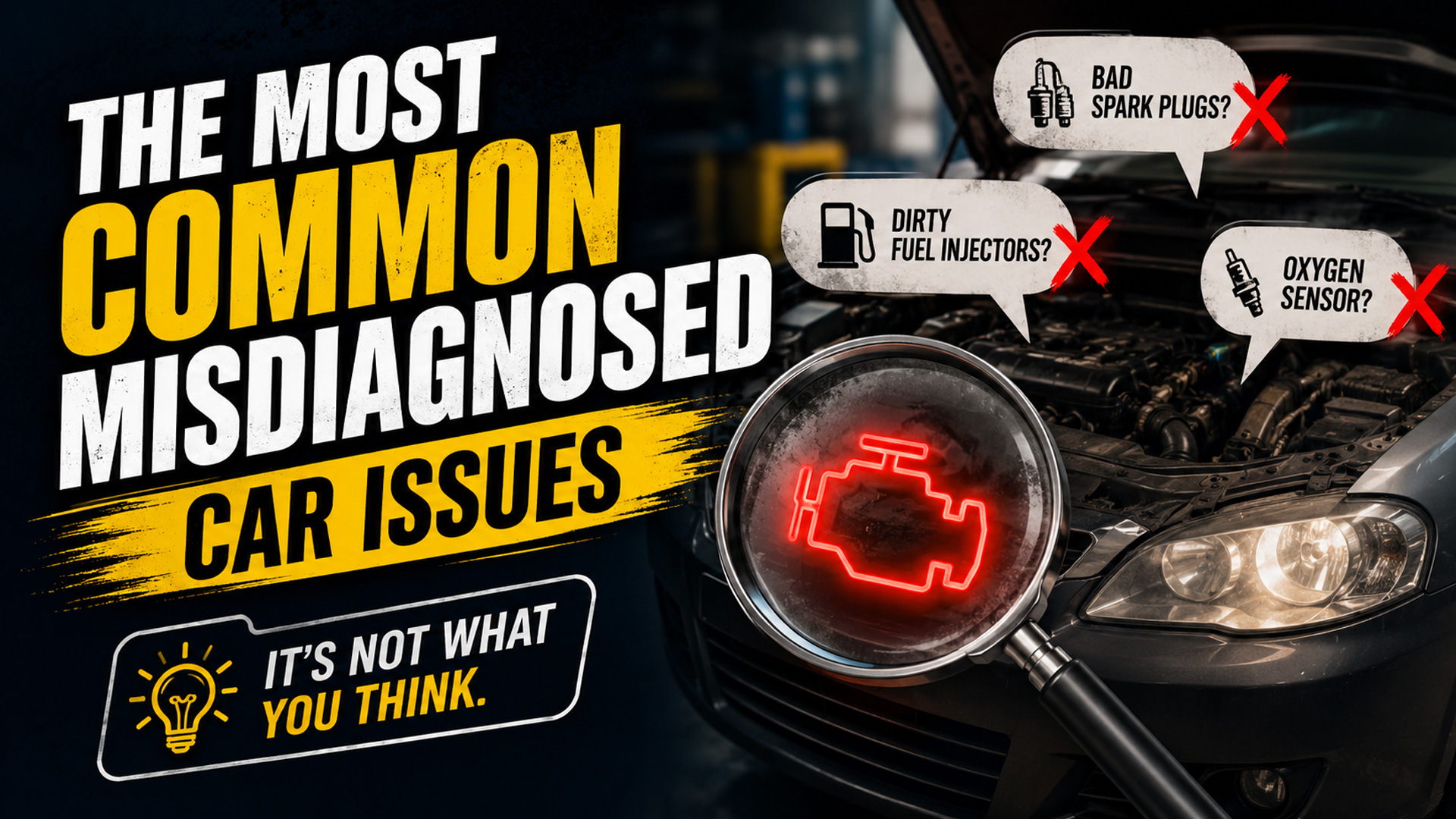
Have you ever taken your car in for a single problem and ended up paying for something completely different? You’re in good company. Misdiagnosis is more common in the world of cars than most drivers think, and it is not always that a mechanic is careless or dishonest.
Nowadays, vehicles are incredibly sophisticated, and in fact, a lot of symptoms that drivers report can be attributed to five or six different main causes. Besides that, when diagnostics are done in a hurry, there is a combination of guesswork and lack of precise testing, and on top of these, the drivers give very vague descriptions of the symptoms, you end up with a bill for repairs that do not solve the problem at all.
In this article, we will identify the most commonly misdiagnosed issues and explain why they can even confuse skilled workshops.
1. The Classic “It’s Your Alternator” (When It’s Actually the Battery, or Vice Versa)
This one happens constantly. A car struggles to start, or the dashboard lights flicker, and the assumption jumps straight to the alternator or the battery without anyone actually testing which one is at fault. The two systems work so closely together that a failing battery can mimic alternator symptoms, and a weak alternator can drain a perfectly healthy battery until it looks dead.
The only real way to tell them apart is a proper load test on the battery and a voltage output test on the alternator while the engine’s running. Skip that step, and you can end up replacing a $200 alternator when a $150 battery would’ve solved the problem, or the other way around.
2. Steering Vibration Blamed on Wheel Balance Alone
Vibration through the steering wheel is one of those complaints that gets an automatic answer: “you need a wheel balance.” Sometimes that’s exactly right. But vibration can also come from a warped brake rotor, worn tie rod ends, a bent rim, uneven tyre wear, or even a failing wheel bearing. Balance is the easiest and cheapest thing to blame, so it’s often the first thing tried, whether or not it’s the actual cause.
If you’ve had your wheels balanced and the vibration is still there, or it only shows up under braking or at certain speeds, that’s a strong clue the real issue is somewhere else entirely.
3. Check Engine Light Misreads
In fact, this might be the single most significant cause of misdiagnosis that concerns us on the road nowadays. A warning light of the engine illumination, a diagnostic scanner tool retrieval of the code, and that code is treated as the final answer instead of a first step, in reality, the diagnostic trouble codes indicate a system or a general area, not necessarily the exact fault part.
For example, a code for a misfire might indicate a spark plug, an ignition coil, a fuel injector, a vacuum leak, or even a wiring problem. Changing parts just following the code, and without additional testing, is one of the most frequent ways drivers have to pay for parts that were never really faulty in the first place.
4. Fuel Consumption Problems Pinned on the Wrong System
When a car shows higher fuel consumption than before, most people first think of the fuel system components, fuel injectors, fuel pump, fuel filter. At times, the problem is exactly there. However, just as often, the reason for a higher fuel intake can be low tyre pressure, a brake caliper sticking, air filter getting blocked up, ignition plugs wearing out, and it can even be as simple as the driver unknowingly changing his/her driving style.
Fuel economy problems only gradually show up so it is really difficult to pinpoint them unless you compare the data over a period of time. That’s why such problems are often simply blamed on the ‘obvious’ fuel-related cause.
5. Clunking or Knocking Noises Assumed to Be Suspension
Any knock or clunk from the front or rear of the car tends to get labelled a suspension problem straight away, and strut mounts or sway bar links are usually the first parts replaced. Sometimes that’s exactly right. But similar noises can come from worn CV joints, loose exhaust heat shields, a failing engine mount, or even something loose in the boot or cabin that’s rattling around and transmitting noise through the body.
A proper diagnosis means road testing, physically checking components under load, and ruling things out systematically, not just replacing the most commonly worn part and hoping.
6. Car Pulling to One Side Blamed on Alignment Every Time
Wheel alignment is a fair first guess when a car pulls to one side, and it’s often correct. But pulling can also be caused by uneven tyre pressure, a dragging brake, a bent chassis component, or even the road’s camber, which is easy to mistake for a mechanical fault, especially on Australian roads that often slope toward the gutter for drainage. If an alignment doesn’t fix the pull, it’s worth looking at brakes and tyres before assuming the alignment reading itself was wrong.
7. Overheating Blamed Solely on the Radiator
An overheating engine gets blamed on the radiator constantly, when the actual cause could be a failing thermostat, a water pump on its way out, a blocked coolant passage, or even a faulty radiator cap that’s not holding pressure properly. Replacing a radiator that wasn’t the problem is an expensive mistake, and it happens more often than most people realise.
Why This Keeps Happening
This is not really a case where mechanics are bad at their jobs. Today’s cars have more and more systems interconnected, and thoroughly diagnosis needs time, testing, and experience. The workshops that manage to get it right all the time are those that view a scan tool code or a symptom only as the beginning of an investigation, not the final answer.
If you are receiving quotes that just throw the symptom and the expensive part without explaining much how they arrived at that, then you should definitely ask what kind of testing was actually done. A good Car mechanic can show you the chain of their thoughts and not just giving you the bill.
In the end, a proper diagnosis at the first time costs you less, saves time, and spares your car from being brought back for the same issue a month later. Before approving a repair, especially one that involves guesswork shrouded in certainty, it is always good asking questions.